- FAQ’s About the Author -
1. What’s the chronological order in which the ALEX COOPER books have appeared?
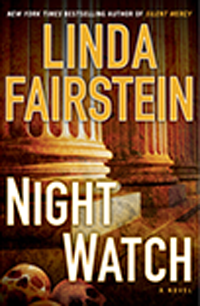
NIGHT WATCH – 2012
SILENT MERCY – 2011
HELL GATE – 2010
LETHAL LEGACY – 2009
KILLER HEAT – 2008
BAD BLOOD – 2007
DEATH DANCE – 2006
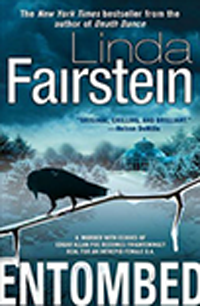
ENTOMBED – 2005
THE KILLS – 2004
THE BONE VAULT – 2003
THE DEADHOUSE – 2001
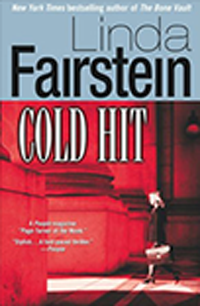
COLD HIT – 1999
LIKELY TO DIE – 1997
FINAL JEOPARDY – 1996
2. Are the restaurants at which Coop eats all real?
Absolutely! She has to eat somewhere, so it might as well be the places that Linda likes best….
In New York City -
PRIMOLA – a delicious Italian restaurant on the Upper East Side – 1226 Second Ave, between 64th and 65th Street – all of coop’s book jackets line the wall. Tell Giuliano or Adolfo that Linda sent you!
RAO’s – a club-like little jewel of an Italian Restaurant in East Harlem – hard to get a reservation, so be sure to call first. If you can’t get in, be sure to buy the cookbook instead. Or go to its spinoff in the theater district, called Baldoria, and tell Frank, Jr. you’ re a friend of Coop’s.
PATROON – the most mouth-watering steak house in the city – on E.46th between Lexington and Third. Ken Aretsky has been a character in the books, and he’ll be very glad to see you. In summertime, try the rooftop bar – it’s one of the city’s most fabulous little spots.
SWIFTY’S – on Third Avenue between 72nd and 73rd Street – great for dinner or lunch – and a perfectly divine place for food, and great nyc people-watching.
PJ BERNSTEIN’s – on Third Avenue off the corner of 70th Street. It’s a classic NY deli – serving overstuffed sandwiches, egg and omelettes, and salads of every kind. A great place to refresh during a shopping spree.
L’ABSINTHE – you’ll think you’ve stepped into a bistro in Paris when you walk in here, on E. 67th Street between Second and Third. All the ambiance, and authentic French food, to make you feel as though you’ve crossed the Atlantic.
FORLINI’s – If you’re in lower Manhattan – and especially if you’re on jury duty – cross the street behind the courthouse and enjoy a delicious meal. (Don’t have any vino if you’re on jury duty!)
And on Martha’s Vineyard -
THE HOMEPORT – a family style lobster restaurant, right on the water. Eat inside, or order at the back door and take your dinner down to the beach and watch the sun set.
THE BITE – Coop’s favorite fried clam shack, and well worth the lines that form in mid-summer. Fried clams, oysters, shrimp, calamari, clam chowder – chicken fingers and bite fries for those who don’t love seafood. Ask Karen – the Baroness von Clam as Mike calls her – and Jackie – and ask for all the local gossip, to.
THE GALLEY – Sit on the rocks edge of the water and enjoy your lobster roll, burger, tuna melt or salad. Don’t forget to have some soft ice cream for the road. Ask for Barbara and enjoy your meal on the rocks at the edge of the water.
THE OUTERMOST INN – One of the most beautiful setting on the island is also one of the finest dining rooms. Jeannie and Hugh Taylor run an elegant inn – small and cozy – with a great restaurant. Hang out at the bar and tell Larry that Linda sent you up for a sunset drink.
THE CHILLMARK STORE – Don’t pass by without stopping for a slice of delicious pizza – the pepperoni is Alex’s favorite – or a tasty wrap to take to the beach. The early morning muffins are sinful, and Stephanie and Bill will make whatever you’d like to eat. And an iced cappuccino will perk you up in the afternoon.
LARSEN’S FISH MARKET – Betsy and Kris Larsen run a fabulous fish market. They’ll cook and crack your lobster for you, sell you the freshest fish on the east coast, and shuck your clams and oysters so you can enjoy the sunset right on the dock.
3. Q&A
Q: In many of your books, a particular New York location or institution is responsible for
much of the atmosphere—in this case it’s the famed New York Public Library. What
inspired you to use the Library as your setting?
A: When I read good fiction, I enjoy being entertained by it, but I also like to come away
having learned something during those hours. Car chases and shoot-outs bore me. In this
series, while Coop and Chapman solve their cases, I’ve had a great time helping them
explore many of New York’s historical institutions. I’ve found that many of these places
look so benign on the surface – our great museums, botanical gardens, cultural centers
for the arts and theater – and yet, there’s often something sinister lurking in their past,
or deep below ground, that heightens the jeopardy for my victims and investigators. I
think the NYPL is the greatest institution in the city, founded in 1895 with the mission
of making the accumulated knowledge of the world freely accessible to all. But once
you get past those two literary lions that guard the entrance to the Library, there is a
fascinating collection filled with breathtaking treasures that one might kill for, if you
knew how to find them. I love the Library and couldn’t wait to introduce readers to all its
wonders.
Q: How did you go about researching the Library? Were you able to get special access?
What’s the most surprising thing you learned about this famed location?
A: Over the years, I’ve met some opposition when I’ve tried to do research in the dark
corners of these famed institutions, so I always approach the task with some trepidation.
In this instance, one of my closest friends is on the board of trustees of the Library and
appreciates my respect and admiration for it – well, at least she did before I made some
of the trustees suspects in a murder investigation. She introduced me to David Ferriero,
the Andrew Mellon Director of the New York Public Libraries, who is not only a
brilliant scholar and librarian, and a voracious reader, but who also has a delightful spirit
and sense of humor. David devoted days to taking me from the rooftop of the central
building to the deepest recesses of the underground stacks, speculating about motives and
murder weapons, and putting me in the hands of curators – each passionate about his or
her collection – who introduced me to the rare documents and priceless maps. Imagine
holding the last letter Keats wrote to Fanny Brawne, sitting at Charlotte Bronte’s writing
desk, examining the first Gutenberg Bible to arrive in America – each visit revealed more
magnificent things. I suppose the greatest surprise to me was the enormous range of
objects – besides books and manuscripts – that are part of the Library’s collection, and
the debates that still rage over what to do with many of them. Some of these remarkable
pieces worked their way into the plot of the book.
Q: You also take readers inside the rarefied world of rare books and maps. Did you have to
do additional research about this fascinating, esoteric world and its denizens?
A: The NYPL, like most other great research libraries around the world, has an amazing
collection of rare maps, half a million of them, in fact, along with 20,000 atlases and
books about cartography. Many of these antique maps, as David Ferriero said, “provide
a window into the past, illustrating how our predecessors perceived of their relationship
with the world,…marking the initial discovery of new lands,…tracing wars and peace
treaties,…following explorers on their journeys.” They are exquisite in their detail and
in the imagination of their creators, many of whom never left their small villages in
Europe but drew images of the New World or China based on legends of sailors who had
voyaged abroad. Yes, the research about rare books and maps – both those in libraries
and in the hands of private collectors – was one of the most riveting aspects of working
on this novel.
Q: Is the character of Eddy Forbes based on a real life criminal?
A: As a young prosecutor in 1974, one of the most interesting and disturbing cases I
handled involved a book thief. He had crossed America, from Seattle to New York,
stealing volumes from research and university libraries, later destroying the books by
ripping maps and prints from them so he could resell them for personal profit. I had this
man in the back of my mind for many years, as I plotted to set a book in my series in
a library setting. Then, in 2005, there were news accounts of a much more audacious,
sophisticated thief, a man named E. Forbes Smiley III, who was actually a scholar and
rare-map dealer, later convicted of stealing scores of books from many major libraries in
the country including dozens from the NYPL. Smiley had won the trust of administrators
and benefactors at the highest level at many of our great institutions, and betrayed that
trust, causing irreparable loss of unique treasures whose value is immeasurable. My story
has a fictional map thief, too, mixed in with a host of other folk who are respectable in
the community but have some very unsavory traits.
Q: In this novel, your eleventh featuring the incomparable Alex Cooper, we get to learn a
little more about her academic side. What would be on Alex Cooper’s reading list?
A: Alex majored in English literature at a great liberal arts college before making her
decision to go to law school. She’s always got a stack of good books on her bedside
table, and when she’s not immersed in a big case, she’s usually reading late into the
night. She is determined to tackle every novel that Anthony Trollope wrote, so she’s
right in the middle of The Way We Live Now (The Eustace Diamonds is her favorite to
date). Must be the prosecutor in her that makes Alex such a fan of crime fiction. She’s
reading an ARC of Richard North Patterson’s upcoming book – Eclipse – and devours
all her favorites: John Grisham, Michael Connelly, Robert Crais, Harlan Coben, Lisa
Scottoline, David Baldacci, Loren Estleman, and looks for newcomers to the genre like
Jonathan Hayes and Kathryn Fox. When she needs a break from the violence, Alex loves
history and historical fiction. She’s trying to get her hands on an early copy of David
Grann’s The Lost City of Z.
Q: Writing crime novels every year is a full-time career, and yet you also devote
considerable time to the issues that consumed you in your previous career (running the
Sex Crimes Unit of the Manhattan DA’s office for twenty-five years). Is there anything
especially exciting in this area that you’re involved with at the moment?
A: I’ve got two passions: literature and the law. Before my legal career began, my dream
was to write novels, so I’ve been extremely fortunate to be able to live in both worlds.
I stay very current with the law, training police and prosecutors around the country,
and I’m on the boards of two non-profit organizations that do wonderful advocacy
work for victims of violence. One is the Joyful Heart Foundation, formed by my great
friend Mariska Hargitay, star of Law and Order: SVU, and the other is Safe Horizon,
the country’s leading victim advocacy group. This winter, Safe Horizon is establishing
Manhattan’s first Child Advocacy Center, a pioneering operation that will place all the
services for children who’ve been sexually or physically abused under one roof. This
safe haven – with police, prosecutors, doctors, social service agencies and mental health
workers on site – will spare kids repeated trips to frightening places like emergency
rooms and stationhouses, and I’m thrilled to be part of the project.
Q: In this book, Coop and her team continue to use cutting-edge forensic techniques.
That’s been another area of interest to you, hasn’t it?
A: As a sex crimes prosecutor, I had a front row seat as forensic science – and especially
DNA technology – began to revolutionize the criminal justice system. In 1986, when
I was handling the Robert Chambers “Preppy Murder” case, the medical examiner
suggested I learn about DNA to see whether we could link the murder weapon to the
defendant. At that time, the only lab in the country doing forensic DNA testing was
the FBI in Quantico. It took six months for them to give me the preliminary result
that Alex would hope to have today in less than forty-eight hours, and once I had it,
the judge refused to allow us to offer the evidence because he didn’t think the science
had yet proven reliable. The advances in this constantly evolving field have been
astounding. It’s no wonder that in this book Alex wants to convince the court to allow
a controversial ‘familial search’ – involving the DNA of a suspect’s relatives when you
can’t get to the perp – to try to solve a brutal cold case for Mike Chapman.
Q: Does the Waldseemuller World Map of 1507 really exist?
A: Antique maps, especially those not bound into books or atlases, present a remarkable
story of survival. They were printed for the purpose of being distributed to sailors,
explorers, military leaders and adventurers for actual use in their travels. So the
likelihood of finding intact maps in good condition from those early times is quite
remote. There were only one thousand copies of the 1507 map printed then, and the one
that was discovered in a private library of a castle in Germany four hundred years later
was considered one of the most remarkable finds in the history of cartography. You can
see this splendid and unusual document – the first map to name our continent AMERICA
– at the Library of Congress. What if…a second map was also sitting on a shelf in
someone’s library today? It would be worth a lot more than the ten million that LOC
paid for the one on display – and might be the cause of some literary intrigue.
Q: What’s next for you?
A: There’s been so much scandal and intrigue in New York politics lately that it was
only a matter of time before Alex and Mike got caught up in an investigation – mayhem,
moxie, madness, and of course…murder. It’s pretty lively behind the scenes at City Hall,
where the stakes are so high for all the politicians. And then there’s Gracie Mansion,
the historic home of Archibald Gracie (a ‘country house’ built in 1799) which has been
the official residence of the Mayor of New York since 1942. But since so many of our
mayors – including Bloomberg and Koch – don’t actually live in the house, what does go
on there? It’s no coincidence the mansion sits on its scenic East River overlook at a spot
called Hell’s Gate.